
Home Insurance Values – Why is my home insured for so much?
Understanding reconstruction cost, market value, and property assessment values
It’s one of the most common questions we hear at renewal time, and it’s a great one to ask. You should never feel like you need to apologize for asking it. It matters to us that you understand what you’re paying for and where the numbers on your policy come from.
The short answer: your home can have several different “values” at the same time, and each one is calculated for a different purpose. The dwelling (building) limit on your home insurance policy should account for the reconstruction cost – what it would cost your insurance company to rebuild your home – not what it would sell for or what the city or municipality has assessed it at.
Three Values, Three Different Purposes
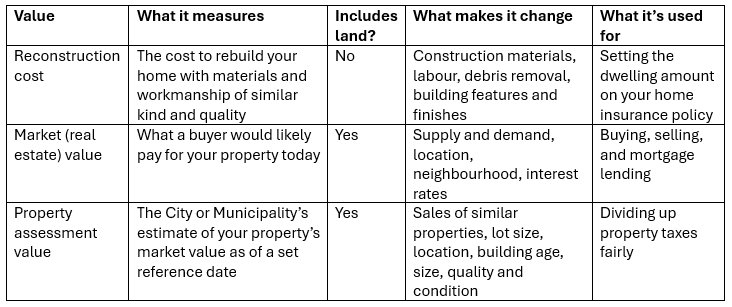
Reconstruction Cost: What It Would Cost to Rebuild
When we insure your home, our goal is to make sure there is enough coverage to rebuild it the same way it is today if it were completely destroyed. The Insurance Bureau of Canada explains that the amount of insurance on your building should correspond to what it would cost to replace it in the event it is completely destroyed. The Insurance Brokers Association of Manitoba puts it simply: insure your home for what it would cost to rebuild it sometime in the coming year.
Our Team will calculate a reconstruction cost using an evaluation tool approved by your insurance company. This evaluation looks at the building itself, not the land it sits on. It considers things like:
- Building materials and current construction prices
- Labour costs for the trades needed to rebuild
- Demolition and debris removal after a loss
- The size, layout, and number of storeys
- Construction type, foundation, roofing, and exterior finishes
- Interior features and finishes, such as bathrooms, kitchens, ceiling heights, fireplaces, and decks
Because it’s tied to construction costs, your reconstruction cost won’t rise and fall with the housing market. It can, however, increase when labour and materials become more expensive, or when you renovate or add features to your home.
Market Value: What Your Home Would Sell For
Market value is what a willing buyer would pay a willing seller for your property – the house and the land – on the open real estate market. It can change significantly with the supply and demand of homes, interest rates, the neighbourhood, nearby schools and amenities, and overall economic conditions.
Since market value includes land and buyer demand, it can be higher or lower than your reconstruction cost. A home on a highly desirable lot may sell for much more than it would cost to rebuild, while an older home in a quieter market may sell for less than it would cost to rebuild today. Neither number is “wrong” – they simply answer different questions.
Property Assessment Value: What the City Uses for Taxes
Your property assessment is the City’s estimate of your property’s value for tax purposes. According to the City of Winnipeg’s general assessment information, properties are assessed at market value – the price the property could normally sell for on the real estate market as of a specific reference date. The City values both the land and buildings by studying sales of similar properties and comparing lot size, location, building age, size, quality of construction, and condition, and it factors in depreciation for normal wear and tear.
These assessments are also based on a past date. Provincial legislation requires a general reassessment every two years, and the 2027 General Assessment reflects market conditions as of April 1, 2025. The purpose of the assessment is to divide property taxes fairly among property owners – not to estimate what it would cost to rebuild your home.
If you live in Winnipeg, you can look up your assessed value using the City’s Property Assessment Search, and learn more about how assessed values affect your taxes on the City’s Understanding Assessed Values & Your Property Taxes page. For properties outside Winnipeg, the Province of Manitoba provides Property Assessment Services.
The Insurance Brokers Association of Manitoba addresses this exact question: city assessors are concerned with what your home would sell for on the open market, while your insurance broker is focused on what it would cost to build a home of the same “like, kind and quality.”
“But My House Cost Less Than That to Build”
From time to time, especially with newly built homes, clients tell us our reconstruction cost evaluation comes in higher than what they paid to build. That can be accurate. Rebuilding after a loss is different from building new on an empty lot. The damaged structure has to be demolished and the debris removed first, and the work must meet current building requirements. Just as importantly, after a loss our priority is to get your home rebuilt as quickly as possible so you can get back into it – and that kind of timeline can cost more than a planned new build.
What About Cost per Square Foot?
Many years ago, home insurance values were often estimated using a simple cost per square foot. That’s no longer how it’s done. Today’s reconstruction cost evaluators consider many more features than square footage alone, which means the result isn’t as simple or standard as a single per-square-foot rate.
A cost per square foot doesn’t account for things like higher ceilings, the number of bathrooms, decks, custom finishes, or the type of roof and foundation. Two homes with the same square footage can have very different rebuilding costs, so a more detailed evaluation gives a more accurate picture of what your home would actually cost to rebuild.
Why Rebuilding Costs Can Change Quickly
Construction costs don’t stand still. Between 2019 and 2025, the price of building new homes across urban Canada rose by almost 70%, according to a review of Statistics Canada data. And costs are still climbing: Statistics Canada’s latest Building Construction Price Index shows residential construction costs in Winnipeg rose 4.0% from the third quarter of 2025 to the third quarter of 2026, compared with 2.7% nationally. Builders have pointed to labour shortages and elevated wages in the skilled trades, along with tariffs and higher fuel and transportation costs, as ongoing pressures.
Material prices can also swing quickly. Natural Resources Canada reported the wholesale benchmark price of 7/16″ OSB sheeting – used for walls and roofs – at $485 CAD per thousand square feet in late October 2026, about 44% higher than its 52-week average of $337. That works out to roughly $15.50 a sheet at the mill, before freight and retail markup.
We’ve seen this first-hand in our homes, and those of our clients and industry partners. One individual received a quote to build a deck, then put the project off for a few years. When he was finally ready to go ahead, the new quote was almost triple the original! Our friends and clients in the construction industry could probably talk your ears off about how quickly material costs can change – and how availability can be just as big a challenge as price.
What Does This Mean for Your Home Insurance?
From a claims perspective, the dwelling building limit on your policy really matters:
- If there is an insured loss at your home, most policies will pay to get you back to the same position you were in before the loss, up to the limit of insurance on the policy. If rebuilding costs more than that limit, the difference could come out of your pocket.
- If your policy includes Guaranteed Replacement Cost, the insurance company has agreed to pay more than the limit of insurance (subject to exclusions), because you’ve met certain criteria of theirs in advance.
Keeping Your Coverage Accurate
Insuring your home for its full reconstruction cost helps make sure you aren’t left paying the difference out of pocket after a major loss. A few ways to keep your coverage on track:
- Tell us about renovations. Finishing a basement, updating a kitchen or bathroom, adding a deck, or building an addition can all increase your rebuilding cost. These additions may not be covered if your policy has not been updated.
- Review your values at renewal. Construction costs change over time, so your dwelling amount may be adjusted to keep pace.
- Ask about Guaranteed Replacement Cost. Ask us whether your policy includes it and what criteria need to be met to keep it in place.
- Don’t use your assessment or sale price as a guide. Neither is designed to reflect what it would cost to rebuild your home.
Questions? We can take care of that!
If you are a Team Insurance client and have concerns about your coverage, or questions about your home’s reconstruction cost or how your dwelling amount was calculated, please call Our Team. We would love to answer any questions you have. If you are not already a Team Insurance client, please give us the opportunity to Take Care of your family and any concerns you have.